Islamic Belief of Finality of
Prophethood
ACCORDING
TO THE QURAN, THE SUNNAH
AND
CONSENSUS OF UMMAH
By: Maulana Muhammad Yusuf Ludhianvi
CONTENTS
INTERPRETERS OF THE HOLY QURAN
·
Imam Hafiz Ibne Katheer
·
Imam Qartabi
·
Hujjat ul Islam, Imam Ghazali
KHATME NUBUWWAT AND AHADITH
·
Hafiz Ibne Hazm
·
Hafiz Ibne Katheer
·
Allama Syed Mahmood Aloosi
HADITH
(1) The Last Brick
HADITH
(2) Line of Prophethood Terminated
HADITH
(3) Address to Hazrat Ali
HADITH (4)
Neither Tashreei Nabi nor Ghair Tashreei Nabi in this Ummah
HADITH
(5) Thirty liars in the Ummah
HADITH
(6) “No Nabi, No Rasool after me.”
HADITH
(7) Last Prophet, Last Ummah
HADITH (8)
If there could be a prophet that would have been Umar
HADITH (9) I
am Hashir, I am Aaqib, I am Muqaffi(Sallallaho Alaihe Wassallam)
HADITH
(10) Forefinger and Middle Finger
CLARIFICATIONS by distinguished elders of
Ummah
·
To claim Prophethood is infidelity
·
To claim Prophethood is unlawful
·
Deniers are infidels
·
Himself misled and misleading others
·
Capital punishment of dualist infidel obligatory
·
Who is a dualist infidel
·
Punishment of a dualist infidel
·
Different types of infidels
·
Dualist infidels publicly guillotined
WRITTEN VERDICTS of Jurists of Ummah
(1) Fatawai Alamgiri
Who
is not a Muslim
(2) Fatawai Bazzazia
Claimant
of Prophethood is an infidel (Kafir)
(3) Bahrur Raiq Sharah Kanzud Daqaiq
Who
is an infidel (Kafir)
(4) Jameul Fasulain
Demander
of miracle from Claimant of Prophethood is also Kafir
(5) Fiqah Shafai’s Mughni
ul Muhtaj Sharah Minhaj
Ten types of Kafir
(6) Fiqah Hambali: Mughni Ibn Qudamah
Follower
of Claimant of Prophethood is also an apostate
(7) Al Sharah al Kabir Sharah al Muqney
TO
CONCLUDE
“ahmedi”
or “qadiyani”?
Islamic Belief of Finality of Prophethood

The holy Quran and the holy
Prophet’s Ahadith (Traditions) eloquently prove that Prophethood (‘nubuwwat’
and ‘risalat’) came to an end with our Prophet Muhammad (Sallallaho Alaihe
Wassallam) There are decisive verses to that effect. Being the last Prophet in
the chain of prophethood no one ever shall now succeed him to that status of
dignity.

“Muhammad is not the
father of any man among you, but he is the Messenger of Allah and the Seal of
the Prophets; and Allah is Aware of all things.”
(Quran, Al-Ahzab
33:40).
INTERPRETERS OF THE HOLY
QURAN
All the interpreters of the holy Quran agree on the meaning
of ‘Khatam-un-Nabieen’ that our Prophet (Sallallaho Alaihe Wassallam)
was the last of all the prophets and none shall be exalted to the lofty
position of Prophethood after him.
that our Prophet (Sallallaho Alaihe Wassallam)
was the last of all the prophets and none shall be exalted to the lofty
position of Prophethood after him.
(1) Imam Hafiz
Ibn-e-Katheer
His explanatory remarks on the above
verse are as follows:
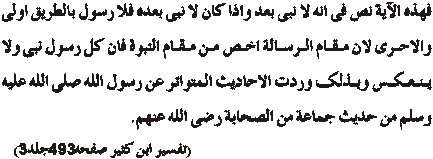
“This verse
is conclusive of the precept that our Prophet is the last prophet and that
there shall be no ‘nabi’ after him. When there shall be no ‘nabi’ to follow him
the ordainment of a ‘rasool’ cannot arise by logic of anteriority because the
status of a ‘rasool’ is more exclusive than that of a ‘nabi.’ Every ‘rasool’ is
a ‘nabi’ but every ‘nabi’ is not a ‘rasool’. There exists a continuous and
unbroken chain of citations of Ahadith from a large number of venerable
‘sahabah’ or Companions of the Prophet (Allah be pleased with them), that there
shall be no ‘nabi’ or ‘rasool’ after Muhammad.( Sallallaho Alaihe Wassallam)”
(Tafseer
Ibn-e-Katheer, Vol. 3, p.493).
NOTE: Every prophet is called
a ‘Nabi’ whether he was given a ‘Shariat’ or not; and the prophet who was given
a ‘Shariat’ is called a ‘Rasool.’
(2) Imam Qartabi
Imam Qartabi comments on the quoted verse as follows:

“Said Ibn-e-Atiya
that the words (Khatam-un-Nabieen) according to the learned men of the Ummah of
the present and the past indicate perfect comprehensiveness and signify, in
consonance with the Quranic injunction, that there shall be no prophet after
Muhammad.(
Sallallaho Alaihe Wassallam)
(3) Hujjat ul
Islam, Imam Ghazali
Hujjat ul Islam, Imam Ghazali
explains the said verse in these words:
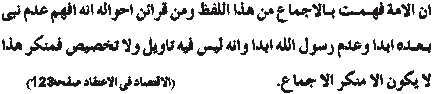
“No doubt the Ummah
has unanimously understood from this word (‘Khatam-un-Nabieen’) and its
circumstantial reference to mean non-existence of a ‘nabi’ or ‘rasool’ ever
after Muhammad (Sallallaho
Alaihe Wassallam) and that (this word calls for) no reservation or tacit
interpretation in it; hence its dissident is certainly the one who rejects
(Ummah’s) unanimity.” (Al
Iqtisad fil Etiqad, p.123)
“KHATME-NUBUWWAT” AND
AHADITH
The Prophet (Sallallaho Alaihe
Wassallam) unequivocally declared that he was ‘Khatam-un-Nabieen.’ There are a
large number of Ahadith to sustain this article of Islamic faith. Not only that
but the Prophet (Sallallaho Alaihe Wassallam) was also pleased to bring forth
such expositions of this word that all doubts relating to his finality in
Prophethood stand void and misinterpretations exposed. Many people having
theological distinctions to their credit have stressed upon the unbroken and
consecutive nature of those Ahadith which concern Khatme-Nubuwwat. Opinions of
some of them are quoted below:
(1) Hafiz
Ibn-e-Hazm says on page 77 (Vol. 1) of his Kitab-ul-FasI:

“All those personages who have dwelt upon the subject of
Muhammad’s (Sallallaho Alaihe Wassallam) Prophethood, his miracles and
expounded the holy Quran, have stated that he (Sallallaho Alaihe Wassallam) had
informed that there would be no prophet after him”.
(2) Hafiz
Ibne-Katheer writes under the caption, ‘Khatam-un-Nabieen’:

“And on this (precept of ‘Khatme Nubuwwat’) there have come
from Allah’s Messenger (Sallallaho Alaihe Wassallam) ‘mutawatir’ ahadith which
have been transmitted by an unbroken chain of his ‘sahabah’. (Allah be pleased
with them).
(Tafseer
Ibne Katheer, Vol. 3, p.493)
(3) Allama Syed Mahmood Aloosi writes in his Tafseer Roohul-Maani under the verse
Khatamun-Nabieen:

“That he (Muhammad) (Sallallaho Alaihe Wassallam) was
‘Khatam-un-Nabieen’ is ordained by the Book (Quran), acknowledged by the
Sunnah, and agreed upon by the Ummah; hence a claimant to the contrary will be
(determined as) Kafir and put to death if (he is) persistent”. (Rooh ul Maani, Vol.
22, p.41).
To conclude therefore, ‘Khatme
Nubuwwat’ is an article of faith by the Quran’s text and ‘mutawatir’ Ahadith.
For the sake of brevity some of them are reproduced below:
HADITH: (1)
THE LAST BRICK
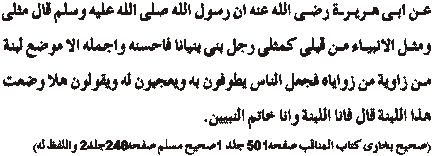
1:1 “From Abu
Hurairah, (Allah be pleased with him): Allah’s Messenger (Sallallaho Alaihe Wassallam)
said: “Certainly my example and the example of prophets earlier than me is like
the example of a palace most elegant and most beautiful constructed by a person
except (that he left in it) a blank space for a brick in one of its corners and
that made the people (who were) going around it wonder (at its marvellousness)
and exclaimed (in perplexion): “Why not is this brick inlaid in here!”. The
Prophet (Sallallaho Alaihe Wassallam) said, “I am that (corner’s last) brick
and I am the last of the prophets”.
(Sahih Bukhari, Vol. 1, p.501 & Sahih Muslim, Vol. 2,
p.248).
1:2 The above Hadith
is also related by Hazrat Jabir bin Abdullah, (Allah be pleased with him,) and
is included in Musnad Ahmad, Sahih
Muslim and Jama-e-Tirmizi. Sahih Muslim’s narration ends with these
words:

“Said Allah’s Messenger (Sallallaho Alaihe Wassallam) So I
am in place of this brick; I came and so I completed the chain of the
prophets’”.
(Musnad Ahmad, Vol. 3, p.361; Sahih Bukhari, Vol. 1, p.501; Sahih
Muslim Vol. 2, p.248; Tirmizi, Vol. 2, p.202; Ibn-e-Abi Shaibah, Vol. 11,
p.499).
1:3 The above Hadith is also related by
Hazrat Abi bin Ka’b, (Allah be pleased with him,) as recorded in Musnad Ahmad and Tirmizi”:
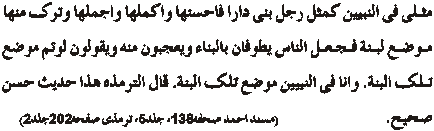
“My example among the
prophets has a likeness (in the sense) that a man constructed a palace most
lovely and perfect and extremely elegant but left the place of one brick
incomplete in it (for subsequent inlaying); then people went around the palace
and wondered (on its excellence) and said, “Would that space for one brick be
also filled up!” The holy Prophet (Sallallaho Alaihe Wassallam) said, “I am in
place of this brick among the prophets”. Imam Tirmizi calls this Hadith
Hasan-Sahih.
(Musnad Ahmad, Vol. 5, P.137 & Tirmizi, Vol. 2, p.202).
1:4 This Hadith is also related in Sahih
Muslim on the authority of Hazrat Abu Saeed Khudri, (Allah be pleased with
him.) In Musnad Ahmad the words
of the Hadith are:
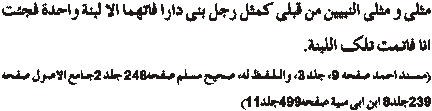
“My example and that
of other Prophets is as though a person constructed a palace and completed it
but left (open) space for one brick only (in it); then I came, and I completed
this one brick.”
(Musnad Ahmad, Vol. 3, p.9; Sahih
Muslim, Vol. 2, p.248,
Jamea ul Usool, Vol. 8, p.539;
Ibn-e-Abi Shaibah, Vol. 11, p.499).
All these Ahadith, given above, are
tangible examples of the precept of ‘Khatme-Nubuwwat’. If human sensibility
plays a fair game, honestly and judiciously, then these Ahadith are obvious in
meaning and no interpretational twisting is called for.
HADITH (2)
LINE OF PROPHETHOOD
TERMINATED
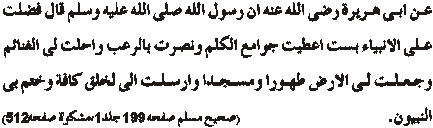
2:1 “From Abu
Hurairah, (Allah be pleased with him): Allah’s Messenger Muhammad (Sallallaho Alaihe Wassallam) said: I have been
bestowed with excellence over (other) Prophets in six respects: (1) I have been
gifted with comprehensive words; (2) I have been supported through awe (being
put in the hearts of enemies) (3) spoils have been made lawful to me; (4) the
whole earth turned into a mosque for me and a means of purification; (5) I have
been ordained as the Prophet for all humanity; and (6) the line of the Prophets
has been terminated with me.”
(Sahih
Muslim, Vol. 1, p. 199; Mishkat, p.512)
2:2 One Hadith
containing similar subject matter is narrated in Sahihain from Hazrat Jabir, (Allah be pleased with him) that the
Prophet (Sallallaho Alaihe Wassallam) said: “I have been gifted with five
qualities not bestowed upon anybody before me.” At the end of this Hadith are
the following words:

“Former prophets were sent to their people alone, whereas I
have been sent as the Prophet to all mankind.” (Mishkat, p.512).
HADITH (3)
ADDRESS TO HAZRAT ALI

3:1 “From Sa’d bin Abi Waqqas, (Allah be pleased with him):
said Allah’s Messenger Muhammad (Sallallaho Alaihe Wassallam) to Hazrat Ali,
(Allah be pleased with him) “You have the same relation with me as Haroon had
with Moosa (peace be on them) except that there shall be no prophet after me.”
(Sahih
Bukhari, Vol. 2, p.633).
3:2 According to another narration in Muslim the words are: “No prophethood after me.” (Sahih Muslim, Vol. 2, p.278).

This Hadith is ‘Mutawatir’ (i.e., it
is transmitted by an unbroken chain of reliable narrators) because, apart from
Hazrat Sa’d, similar narrations are accredited to the following distinguished
Sahabah, (Allah be pleased with them):
3:3
Hadith from Hazrat Jabir bin
Abdullah; (Allah be pleased with him).
(Recorded
in Musnad Ahmad, Vol. 3, p.338)
(Recorded
in Tirmizi,Vol. 2, p.214)
(Recorded
in Ibn-e-Majah, p.12)
3:4 Hadith from Hazrat Umar,
(Allah be pleased with him).
(Recorded in Kanzul Ummal, Vol. 11, p.607, Hadith No. 32934).
3:5 Hadith from Hazrat Ali,
(Allah be pleased with him).
(Recorded in
Kanz, Vol. 13, p. 158, Hadith No. 36488 and in Majmauz Zawaid, Vol. 9, p.110).
3:6 Hadith from Asma bint Amees,
(Allah be pleased with her).
(Recorded in
Musnad Ahmad, Vol. 6, p.438, and in Majma, Vol. 9, p. 109: and in Kanz, Vol.
11, p.607, Hadith No. 32937).
3:7 Hadith from Abu Saeed Khudri
(Allah be pleased with him.)
(Recorded in
Majma, Vol. 9, p. 109 and in Kanz, Vol. 11, p.603, Hadith No. 32915).
3:8 Hadith from Abu Ayub Ansari,
(Allah be pleased with him).
(Recorded in Majma, Vol. 9, p. 111).
3:9 Hadith from Jabir bin
Samrah, (Allah be pleased with him).
(Recorded in Majma, Vol. 9, p. 110)
3:10 Hadith from Umme Salma,
(Allah be pleased with her).
(Recorded in Majma, Vol. 9, p. 109).
3:11 Hadith from Bra bin Aazib
(Allah be pleased with him).
(Recorded in Majma, Vol. 9, p. 111).
3:12 Hadith from Zaid Bin Arqam,
(Allah be pleased with him).
(Recorded in Majma, Vol. 9, p. 111).
3:13 Hadith from Abdullah bin
Umar, (Allah be pleased with them).
(Recorded in
Majma, Vol. 9, p. 110 and in Khasais Kubra Suyutee, Vol. 2. p. 249).
3:14 Hadith from Hubshi bin
Junadah, (Allah be pleased with him).
(Recorded in
Majma, Vol. 9, p. 109 and in Kanz, Vol. 13, p. 192, Hadith No. 36572).
3:15 Hadith from Malik bin Hassan bin
Huwarith, (Allah be pleased with him).
(Recorded in Kanz, Vol. 11, p. 606, Hadith No.32932).
3:16 Hadith from Zaid bin Abi
Aufa, (Allah be pleased with him).
(Recorded in Kanz, Vol. 13, p. 105, Hadith No.36345).
3:17 Hadith from Hazrat Muawiah
(Allah be pleased with him).
(Recorded in Minassawaiq-al-Mohriqah, p.179)
3:18 Ibn-e-Abbas, (Allah be pleased with
them). (Al-Musnad, Vol. 1, p.331;
Majma, Vol.9, p. 109).
It should be noted that a Hadith which is accredited to more
than ten distinguished Sahabah, (Allah be pleased with them), is classified
among the Ahadith Mutawatirah as per decision of the noted Muhadditheen
(Tradition Narrators). Since there are more than ten accreditions in this case,
Hazrat Shah Waliullah Muhaddith Dehlavi, (Allah’s mercy on him), has included
it among the ‘mutawatirat’. He writes in his Izalat-ul-Khifa under the caption, Maathir-e-Ali”( Allah be pleased with him):

“From among the Mutawatir Ahadith there is a Hadith that the
holy Prophet (Sallallaho Alaihe Wassallam)said to Hazrat Ali (Allah be pleased
with him) “Thou art to me in the same position as Haroon was in relation to
Moosa.” (Allah’s peace be upon them).
(Izalatul
Khifa Mutarjam, Vol. 4, p.444. Printers: Qadeemi Kutub Khana, Karachi).
HADITH (4)
Neither Tashreei Nabi’
Nor
Ghair Tashreei Nabi’ in this Ummah
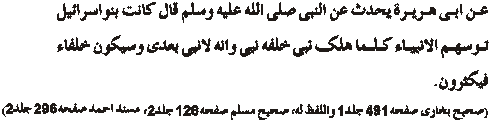
4:1 “Abu Hurairah (Allah be pleased with him) relates from
the Prophet ................that the Bani Israel were led by their own
prophets; when one prophet died, another prophet took his place but there shall
be no prophet after me except that there shall be Caliphs and they will be
many.”
(Sahih Bukhari, Vol. 1, p.491,Sahih Muslim, Vol. 2, p. 126,
Musnad Ahmad, Vol. 2, p.297)
It is well-known that the prophets
who came among the Bani Israel did not bring with them any new Shariat (Divine
Statutes); they only strengthened those laws which were sent down earlier
through Hazrat Moosa, (peace be on him), because they were simply ‘ghair
tashreei’ prophets.
NOTE: ‘Tashreei Nabi’ means
Prophet with a Shariat; ‘Ghair Tashreei Nabi’ means Prophet without a new
Shariat.
4:2
In the case of our Prophet
(Sallallaho Alaihe Wassallam) even such prophets will not come, except that
there shall be religious revivalists of the Ummah. They will come most
certainly as is related in the Hadith of Abu
Dawood and others:

“Verily, Allah the Exalted will send down to this Ummah such
men at the head of every century as will revive the Deen for it.”
(Abu
Dawood, Vol. 2, p.233).
HADITH (5)
THIRTY LIARS IN THE
UMMAH

5:1 It is related
by Hazrat Thauban, (Allah be pleased with him) that our Prophet (Sallallaho
Alaihe Wassallam) said, “In my Ummah there shall be born thirty liars; each of
them will pretend that he is a prophet but I am the last of the prophets; there
shall be no prophet after me.” (Abu Dawood, Vol. 2, p.228;Tirmizi,
Vol. 2, p. 45).
This Hadith is also Mutawatir. Besides Hazrat Thauban (Allah
be pleased with him), the following venerable Sahabah, (Allah be pleased with
them all), have also related it:
5:2 Hadith from
Hazrat Abu Hurairah, (Allah be pleased with him).
(Recorded in
‘Sahih Bukhari’, Vol. 1, p. 509, and ‘Sahih Muslim,’ Vol. 2, p.397).
5:3
Hadith from Hazrat Nuaim bin Masud,
(Allah be pleased with him).
(Recorded in
‘Kanzul Ummal’ Vol. 14, p. 198, Hadith No. 38372).
5:4
Hadith from Abu Bakrah, (Allah be
pleased with him).
(Recorded in
Mushkil ul Aasar, Vol. 4, p.104).
5:5
Hadith from Abdullah bin Zubair,
(Allah be pleased with them).
(Recorded in
Fath ul Bari, Vol. 6, p.617, Hadith No.3609).
5:6
Hadith from Abdullah bin Amr, (Allah
be pleased with them).
(Recorded in Fath ul Bari, Vol.
13, p.87, Hadith No. 7121).
5:7
Hadith from Abdullah bin Masud, (Allah be pleased with him).
(Recorded in
Fath ul Bari, as above).
5:8
Hadith from Hazrat Ali, (Allah be pleased with him).
(Recorded in Fath ul Bari, as
above).
5:9
Hadith from Hazrat Samurah, (Allah be pleased with him).
(Recorded in Fath ul Bari, as
above).
5:10
Hadith from Hazrat Huzaifah, (Allah be pleased with him).
(Recorded in Fath ul Bari, as above).
5:11
Hadith from Hazrat Anas, (Allah be pleased with him).
(Recorded in Fath ul Bari, as
above).
5:12
Hadith from Hazrat Noman bin Bashir, (Allah be pleased with him).
(Recorded in Majmauz Zawaid, Vol.
7, p.334).
NOTE: The text of all these Ahadith has been narrated in
Majmauz Zawaid, Vol. 7, P. 332-334.
HADITH (6)
NO NABI NO RASOOL AFTER
ME

6:1 “From Anas bin Malik, (Allah be pleased with him):
Allah’s messenger Muhammad (Sallallaho Alaihe Wassallam) said: “Verily,
‘risalat’ and ‘nubuwwat’ are terminated; so there shall be neither a ‘rasool
nor a nabi’ after me’. Imam Tirmizi calls this Hadith as ‘Sahih’ and Hafiz Ibne
Katheer says that Imam Ahmad wrote it in his Musnad.
NOTE: Every prophet is called a ‘Nabi’ whether he was given a
‘Shariat’ or not; and the prophet who was given a ‘Shariat’ is called a
‘Rasool’.
6:2
On the authority of Abu Yala, Hafiz
Ibne Hajr, (Allah’s mercy on him) ended this Hadith with the following words:

“But joyful tidings shall continue to be!” The Sahabah
(Allah be pleased with them) asked, “What (are) joyful tidings”? The Prophet
(Sallallaho Alaihe Wassallam) said, “(It is) the dream of a believer which is a
part of the ingredients of Prophethood”. (Fath ul Bari, Vol. 12,
p.375)
This subject matter of Hadith is also related from the
following Sahabah (Allah be .pleased with them).
6:3
Hadith from Hazrat Abu Hurairah,
(Allah be pleased with him).
(Recorded in Sahih Bukhari, Vol. 2, p.
1035).
6:4
Hadith from Hazrat Ummul Momineen,
Aishah Siddiqah, (Allah be pleased with her).
(Recorded in Kanzul Ummal, Vol.
15, p.370, Hadith No. 41419 and in
Majmauz Zawaid, Vol. 7, p.172).
6:5
Hadith from Hazrat Huzaifah bin
Aseed, (Allah be pleased with him)
(Recorded as in 6:4 above).
6:6
Hadith from Hazrat Ibne Abbas,
(Allah be pleased with them).
(Recorded in Sahih Muslim, Vol.
1, p.191 and Sunan-e-Nasai: Vol. 1, p.186, and
Abu Dawood Vol. 1, p.127 and Ibne
Majah, p.278).
6:7
Hadith from Umme Karzenil K’abia,
(Allah be pleased with her).
(Recorded in Ibne Majah, p.278
and Ahmad, Vol. 6, p.381 and Fath ul Bari, Vol. 12, p.375).
6:8
Hadith from Abul Tufail, (Allah be
pleased with him).
(Recorded in Musnad Ahmad, Vol. 5, p.454 and
Majma uz Zawaid, Vol. 7, p. 173).
HADITH (7)
LAST PROPHET: LAST UMMAH
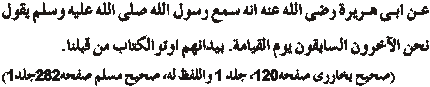
7:1 “From Abu
Hurairah (Allah be pleased with him): I heard the Prophet (Sallallaho Alaihe
Wassallam) saying “We are the last (Ummah) but will precede all on the Day of
Resurrection except that the Book was given to them before us”.
(Sahih
Bukhari, Vol. 1, p. 120; Sahih Muslim, Vol. 1, p.282).
In this Hadith, the Prophet
(Sallallaho Alaihe Wassallam) has mentioned himself as the last of all the
prophets and his Ummah as the last of all the Umam. This subject matter appears
in several Ahadith as referred to below:

7:2 “Hadith from
Hazrat Huzaifah Nibnil Yamaan, (Allah be pleased with him) that the holy
Prophet (Sallallaho Alaihe Wassallam) said,
“We came in the last among the people in the world and shall be the first among
the created to be judged on the Day of Resurrection.”
(Recorded
in Sahih Muslim, Vol. 1, p.282, and
in Nasai, Vol. 1, p.202).
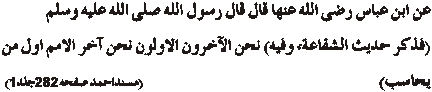
7:3 “Hadith from
Hazrat Ibn-e-Abbas, (Allah be pleased with them) that the holy Prophet (Sallallaho
Alaihe Wassallam) said in (Hadith-e-Shafa’at) “We are the last and the first.
We came after all peoples and we shall precede all (on the Day of Judgement) in
getting adjudged.” (Musnad Ahmad,Vol. 1,
p..282).

7:4 “From Hazrat
Aishah (Allah be pleased with her): The Prophet (Sallallaho Alaihe Wassallam)
said I am the last Prophet and my mosque is the last mosque among the mosques
of all the prophets.”
(Kanzul Ummal, Vol. 12, p.270, Hadith No. 34999).

7:5 “From Abu
Hurairah (Allah be pleased with him): Allah’s Prophet Muhammad (Sallallaho
Alaihe Wassallam) said, “I was
first among the Prophets in creation and the last of them to be sent as the
Prophet into the world.”
(Kanzul Ummal, Vol. 11,
p.452, Hadith No. 32126).
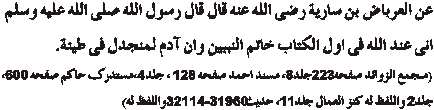
7:6 “From Arbaz bin Saria (Allah be pleased with him):
Allah’s Messenger, Muhammad (Sallallaho Alaihe Wassallam) said: “To Allah I was
‘Khatam-un-Nabieen’ (the last Prophet) in Lauhe Mahfooz, (the Guarded Tablet) while the leaven of
Adam (peace be upon him) was still under fermentation.”
(Musnad Ahmad, Vol. 4, P.127-128; Mustadrak Hakim, Vol. 2,
P.600;
Majma uz Zawaid, Vol.8, P.223).

7:7 “From Abu
Hurairah (Allah be pleased with him) in Hadith-e-Shafa’at (Hadith of
Intercession): On the Day of Judgement, after having approached other prophets,
(Allah’s peace be on them) the people (on the advice of Hazrat Isa (Jesus),
(Peace be on him), will go to Muhammad (Sallallaho Alaihe Wassallam) and will
say: “Ya Muhammad, you are Allah’s messenger and the last of the Prophets………
(Sahih
Bukhari, Vol.2, p. 685).

7:8 “From Hazrat
Jabir, (Allah be pleased with him): Said the Prophet (Sallallaho Alaihe
Wassallam) “I am the leader of all the Prophets but I don’t pride (myself on
it) and I am the last of all the Prophets but I don’t pride (myself on it) and
I shall be the first intercessor and my intercession will be the first to be
accepted but I don’t pride (myself on it).”
(Sunan Darmi, Vol. 1, p.31 & Kanzul Ummal, Vol. 11,
p.404, Hadith No. 31883).

7:9 “Abdullah bin
Amr bin Aas (Allah be pleased with them) related that once Allah’s Prophet Muhammad
(Sallallaho Alaihe Wassallam) came
out to us as if he was parting away (from us for ever) and said thrice ‘I am
Muhammad ‘Nabi Ummi’ (Prophet who did not learn anything from any human) and
there shall be no prophet after me.” (Musnad Ahmad, Vol. 2,
P.172, 212).
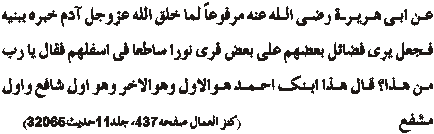
7:10 “Hazrat Abu
Hurairah, (Allah be pleased with him) relates a saying of the Prophet
(Sallallaho Alaihe Wassallam) that
when Allah, the Exalted, created Adam (peace be on him), He put Adam’s progeny
to test and made him behold the excellence of some over others; then Adam saw a
ray of light flashing up below them (i.e., his progeny), he asked: “O
Preserver, who is this”? Allah said, “This is your son Ahmad, he is the first
and he is the last and he is the first intercessor and his will be the first
intercession which shall be granted consent.”
(Kanzul Ammal, Vol. 11, p.437, Hadith No.32056).
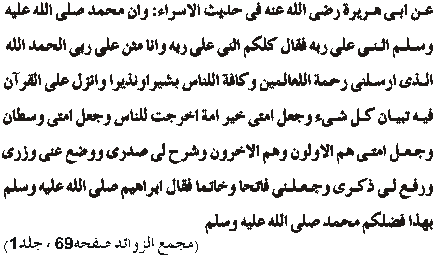
7:11 “From Abu
Hurairah, (Allah be pleased with him), it is related in Hadith-e-Meraj that (in
the gathering of the Prophets, (Sallallaho Alaihe Wassallam) by way of
affirming Allah’s blessings, the Prophets (Sallallaho Alaihe Wassallam)
eulogized and praised the Almighty Allah) and Muhammad (Sallallaho Alaihe
Wassallam) also praised his Preserver and said, addressing other Prophets: “You
have praised your Preserver and now I eulogize my Preserver in these words: All
praise to Allah Who made me as Mercy for the worlds, an Apostle of good news
(for those doing good deeds) and carrying warnings (for those doing evil deeds)
and sent down the Quran on me in which there is information about every
(important) matter (of Deen) and made my Ummah the best Ummah, brought forth
for the welfare of the people and made my Ummah a moderate Ummah and made my
followers (such as they are) the first and the last and opened for me my heart
and removed my (heavy) load from me and exalted my mention for my sake and made
me the opener and the terminator.” Hearing this Hazrat Ibrahim, (Allah’s peace
be upon him), addressing the gathering of venerable prophets (Peace be upon
them), said, “It is because of all these matters that Muhammad (Sallallaho
Alaihe Wassallam) has taken precedence over all of you.” (Majmauz Zawaid, Vol. 1, P. 69)
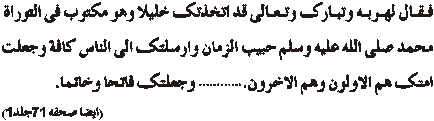
“It is also narrated in the same Hadith-e-Meraj that Allah
the Exalted and Glorious said to Muhammad (Sallallaho Alaihe Wassallam): Surely
I have taken you as my true friend and that is written in Tourat (Torah) that
Muhammad (Sallallaho Alaihe Wassallam) is Rahman’s (Allah’s) loved-one and I
sent you as the Prophet for the entire mankind and made your Ummah such as they
are the first and they are the last ..... and made you first among the
prophets, creation-wise, and last of them in the chain of Prophethood”. (Majmauz Zawaid, Vol. 1, P. 71).
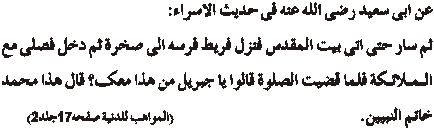
7:12 “Hazrat Abu
Sa’eed, (Allah be pleased with him) related in Hadith-e-Meraj: Then he
(Sallallaho Alaihe Wassallam).... proceeded till he arrived in Baitul Maqdis;
then he alighted; and fastened his horse to a rock; then he entered and offered
‘salat’ along with angels. (When prayers were finished) the angels asked, “O,
Jibreel; Who is this with you”? He replied, “This is Muhammad Khatamun
Nabieen”.
(Al Mawahib ul
Laduniya, Vol. 2, p.17).

7:13 “Hazrat Ali,
(Allah be pleased with him) describing virtues of the Prophet (Sallallaho
Alaihe Wassallam) says: “Between his shoulders was the signet of prophethood
and he (Sallallaho Alaihe Wassallam) was Khatamun-Nabieen”.
(Shamail-e-Tirmizi,
p.3).

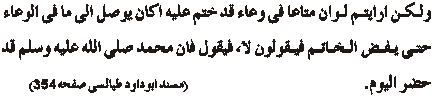
7:14 “Hazrat Ibne
Abbas, (Allah be pleased with them), relates in Hadith Shafa’at that people (on
the Resurrection Day, after having approached Hazrat Adam, Hazrat Nooh, Hazrat
Ibrahim, Hazrat Moosa) (Allah’s peace on them all), will go to Hazrat Isa,
(peace be upon him), (requesting him to intercede). He will have this excuse,
“I am not capable for it because my mother and I were deified besides Allah”.
Then he will say, “Alright, tell me, if there is something (placed) inside a
container whose lid is sealed, is it possible to reach up to what is inside the
container, unless the seal is broken”? They (i.e., the people) will reply in
the negative. Then he will tell them, “Muhammad (Sallallaho Alaihe Wassallam)
is present here today, go to him”.
(Musnad Abu Dawood
Tyalisi, p.354).
The purpose of Hazrat Isa, (peace be on him), from this
simile is that the holy Prophet (Sallallaho Alaihe Wassallam) is Khatamun
Nabieen, i.e., the seal of the Prophets. Therefore until such time as this seal
is not removed and his intercession is not started, other prophets cannot
intercede on their own; nor can intercession come forth from any prophet. For
this reason, Hazrat Isa (peace be on him) advised the people to approach the
holy Khatamun Nabieen (Sallallaho Alaihe Wassallam) to have the prophetic seal
opened and get the process of prophetic intercession commenced. Then alone
could any other prophet intercede.

7:15 “From Abu
Amamah-al-Bahli, (Allah be pleased with him): The Prophet (Sallallaho Alaihe
Wassallam) said I am the last Prophet and you are the last Ummah”. (Ibne Majah, p.297).
7:16 Hazrat Abu Quteela, (Allah be pleased with
him), relates a Hadith that the Prophet (Sallallaho Alaihe Wassallam) said in
his sermon spoken on the occasion of Hajjat ul Wida:

“No prophet after me and no Ummah after you”.
(Majma uz Zawaid, Vol. 3, p.273; Kanzul Ummal Vol. 15,
p.947, Hadith No.43638).
7:17
Imam Behaqi relates a Hadith from
Hazrat Zahak bin Nofil, (Allah be pleased with him) in Kitab ur Roia.

“Allah’s messenger Muhammad (Sallallaho Alaihe Wassallam)
said: “No prophet after me and no Ummah after my Ummah”.
(Khatme
Nubuwwat Kamil, p.272).
7:18
Tibrani and Behaqi have related a
Hadith from Ibne Zumail Johani (Allah be pleased with him), in which the
Prophet (Sallallaho Alaihe Wassallam) interpreted
a dream the last part of which was:

“But the female camel which you saw lifting me up is the
Resurrection Day, which will set upon us; no prophet after me and no Ummah
after my Ummah”.
(Khasais-e-Kubra Sayoti,
Vol. 2, p. 178).

7:19 “Hazrat Abu
Zar, (Allah be pleased with him) relates that Allah’s Messenger Muhammad
(Sallallaho Alaihe Wassallam) said: O Abu Zar the first Prophet among the
prophets is Adam (Peace be on him) and the very last Prophet is Muhammad”.
(Kanzul Ummal, Vol. 11,
p. 480, Hadith No.32269).

7:20 “Ayub bin
Moosa (Allah be pleased with him) relates a Hadith that the Prophet (Sallallaho
Alaihe Wassallam) said, ‘I have been sent as the victorious and the last
Prophet’”. (Ibne Abi Shaibah, Vol. 11, p.500).
HADITH (8)
IF THERE COULD BE A
PROPHET THAT WOULD HAVE BEEN UMAR

8:1 It is
narrated by Uqba bin Aamer, (Allah be pleased with him) that Allah’s Messenger
Muhammad (Sallallaho Alaihe Wassallam) said, “If there could ever be a prophet
after me, indeed Umar bin Khattab would have been such”.
(Tirmizi, Vol. 2, p.209).
8:2
The above Hadith is also related by
Hazrat Abu Saeed Khudri, (Allah be pleased with him). (Fath ul Bari, Vol. 7, p.51, and Majma uz
Zawaid, Vol. 9, p.68).
8:3
Majmauz Zawaid, Vol. 9, p.68, also contains this Hadith, related
by Asmah bin Malik, (Allah be pleased with him).
The word “ ”
with which the foregoing Hadith starts in Arabic and is translated into English
by the word, “if”, is grammatically in ‘Subjunctive Mood” which denotes a
supposition which is impossible. The word “” is used in Arabic language in those situations where a
supposition or wish is expressed which is impossible to happen. Therefore, the
sense of this Hadith is that despite Hazrat Umar’s perfect worthiness for the
status of prophethood he could never be a prophet because prophethood was an
impossible occurrence after Muhammad.
”
with which the foregoing Hadith starts in Arabic and is translated into English
by the word, “if”, is grammatically in ‘Subjunctive Mood” which denotes a
supposition which is impossible. The word “” is used in Arabic language in those situations where a
supposition or wish is expressed which is impossible to happen. Therefore, the
sense of this Hadith is that despite Hazrat Umar’s perfect worthiness for the
status of prophethood he could never be a prophet because prophethood was an
impossible occurrence after Muhammad.
Imam
Rabbani, Mujaddid Alf Thani says:
“The Prophet (Sallallaho Alaihe Wassallam) has spoken for the eminence of Hazrat
Umar Farooq, (Allah be pleased with him), that “If there could ever be a
prophet after me indeed Umar Khattab would have been such”. It means that
Hazrat Umar Khattab, (Allah be pleased with him), has all the requisites and
excellences necessary for prophethood but he was not honoured with (the good
fortune of) prophetic status because this (dignified) rank stood terminated (ipso-facto) on Khatam ur Rusul”
(Sallallaho Alaihe Wassallam) (Maktub No. 24, Vol. 3, p.23).
HADITH (9)
I AM ‘HASHIR’, I AM
‘AAQIB’
I AM ‘MUQAFFI’
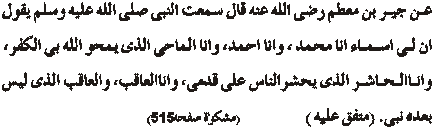
9:1 “Hazrat
Jubair bin Mut’am, (Allah be pleased with him) says: I heard the Prophet
(Sallallaho Alaihe Wassallam) saying, “Certainly there are some names for me; I
am Muhammad, I am Ahmad, I am Mahi the obliterator as Allah shall blot out
‘kufr’ through me and I am ‘Hashir’, the gatherer of people who shall be
resurrected at my feet and I am ‘Aaqib’ the last to come as there shall be no
prophet after me”.
(Mishkat, p.515).
In this Hadith there are two words
that prove the fact of his being the last of all the Prophets. One is Al Hashir
(“gatherer of people”). Hafiz Ibne Hajr comments on this word in Fath ul Bari as follows:

“This is an allusion towards the fact that there shall be
neither any prophet nor any Shariat after him (Sallallaho Alaihe Wassallam) So
when there is no Ummah after his Ummah and no prophet after him, therefore
Resurrection has been related to him and Resurrection shall certainly be held
after his arrival.
(Fath ul Bari, Vol. 6,
p.557).
The Prophet’s second dignified name is Al Aaqib, i.e., ‘the
last to come’. This word is explicated by the Hadith itself, viz., “No prophet
after him”.

The subject matter of this Hadith is
also related by the following Sahabah, (Allah be pleased with them).
9:2
Hazrat Abu Moosa Ash’ari, (Allah be
pleased with him), in whose Hadith, the words are:

“Allah’s Messenger, Muhammad (Sallallaho Alaihe Wassallam)
enumerated to us some names for himself. So he said: I am Muhammad; I am Ahmad;
I am Muqaffi, the last to come after all the Prophets; I am ‘Hashir’ (the
gatherer of people on the Resurrection Day); I am the Prophet of repentance and
the Prophet of mercy”.
(Sahih Muslim, Vol. 2,
p.261).

9:3 In the Hadith
of Hazrat Huzaifah (Allah be pleased with him), the words are: The Prophet
(Sallallaho Alaihe Wassallam) said, “I am Muhammad; I am Ahmad; I am the
Prophet of mercy and the Prophet of repentance; I am Muqaffi the last Prophet
to come; I am Hashir (the gatherer of people, on the Resurrection Day); and I
am the Prophet of war (for the right cause)”.(Shamail Tirmizi, p.26; Majmauz Zawaid)

9:4 The following
words are mentioned in the Hadith from Hazrat Jabir bin Abdullah, (Allah be
pleased with him): “I am Ahmad; I am Muhammad; I am Hashir the gatherer of
mankind (on the Resurrection Day) as people will be gathered at my feet”. (Majma uz Zawaid, Vol. 8, p.284).

9:5 Hazrat
Ibn-e-Abbas, (Allah be pleased with them), in whose narration there are these
words: “I am Ahmad and Muhammad and the gatherer of people on the Resurrection
Day and the last to come; and I am the seal (of the Prophets).
(Majmauz
Zawaid, Vol. 8, p.284).

9:6 Hazrat Mursal
Mujahid, (Allah be pleased with him), whose Hadith contains these words: “I am
Muhammad and Ahmad; I am the Prophet of mercy; I am the Prophet of good news; I
am the last to come and the gatherer of people on the Resurrection Day and I am
commissioned for holy war and not commissioned as a farmer”. (Tabaqat-e-lbne
Saad, Vol. 1, p. 105).
9:7
Hazrat Abul Tufail, (Allah be
pleased with him); (on the same lines).
(Fath ul Bari, Vol. 6, p.555)
HADITH (10)
FOREFINGER AND MIDDLE
FINGER
There are many Ahadith on record
that Allah’s Prophet (Sallallaho Alaihe Wassallam) pointed towards his
forefinger and the middle one and said: “I and Resurrection have been sent like
these two fingers”.

The above subject matter is also
corroborated by the following Ahadith:
10:1
Sahl bin Sa’d, (Allah be pleased with
him).
(Bukhari, Vol. 2, p. 963; Muslim,
Vol. 2, p.406).
10:2
Abu Hurairah (Allah be pleased with
him).
(Bukhari, Vol. 2, p. 963).
10:3
Anas bin Malik (Allah be pleased with
him).
(Bukhari, Vol. 2, p.963; Muslim,
Vol. 2, p.406).
10:4 Mustaurad bin Shaddad, (Allah be pleased
with him).
(Tirmizi, Vol. 2, p.44).
10:5
abir bin Abdullah, (Allah be pleased
with him).
(Muslim,
Vol. 1, p.284 and Nasai, Vol. 1, p.234).
10:6 Sahl bin Hunaif, (Allah be pleased with
him).
(Jamea ul Usool, Vol. 10, p.385).
10:7
uraidah (Allah be pleased with him).
(Musnad Ahmad, Vol. 5, p.348).
10:8
Abi Jubairah, (Allah be pleased with
him).
(Majma uz Zawaid, Vol. 10, p.312).
10:9
Jabir bin Samorah, (Allah be pleased
with him).
(Musnad Ahmad, Vol. 5, p. 103).
10:10 Wahb us Suwai, (Allah be pleased with him).
(Majma uz
Zawaid, Vol. 10, p.311).
10:11
Abu Juhaifah, (Allah be pleased with
him).
(Kanz, Vol.
14, p.195; and Musnad, Vol. 4, p.309).
In all the foregoing Ahadith,
contiguity of the Resurrection Day with the Prophethood of Muhammad (Sallallaho
Alaihe Wassallam) has been mentioned, meaning thereby that the arrival of the Prophet
is a sign that the Resurrection is at hand and that there shall be no prophet
till the Resurrection.
Therefore, Imam Qartabi writes in
Tazkirah:
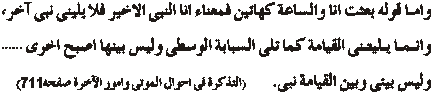
“His saying that “I and Resurrection have been sent like
these two fingers” means that “I am the last Prophet and there shall be no
prophet after me; after me there is just Resurrection; just as the forefinger
is next to the middle one with no finger intervening similarly no prophet shall
intervene between me and the Resurrection”.
(Al Tazkirah fi
Ahwal-ul-Mauta, p. 711).
Allama
Sindhi, (Allah’s mercy on him), writes in his Hashiah Nasai:

“The above simile highlights the fact of contiguity between
them (i.e., the fingers). Just as there is no finger in between the two so also
there is no prophet in between Muhammad (Sallallaho Alaihe Wassallam) and the
Resurrection”.
(Hashiah
Sindhi on Nasai, Vol. 1, p.234).
CLARIFICATIONS BY
DISTINGUISHED ELDERS OF
UMMAH
‘Khatme Nubuwwat’ (the end of
Prophethood) is an article of faith in Islam and this is borne out by Ayat of
the holy Quran and Ahadith of the Prophet (Sallallaho Alaihe Wassallam) reported from him consistently
without any break in the chain of narration. Therefore, as an article of faith
for Islamic Ummah this belief is upheld by an unbroken line of traditions that
prove that Muhammad (Sallallaho Alaihe Wassallam) is the last prophet and
nobody can step on the prophetic stance after him. Therefore, a person who
claims to be a prophet is an infidel, apostate or a pretender and he is
extraneous to the Islamic fold.
Views of some distinguished
personages of Islam are given below:
To
claim Prophethood is infidelity
(1) Allama Ali Qari, (Allah’s
blessing be upon him) wrote in his Fiqah
Akbar:

“To claim Prophethood after the holy Prophet Muhammad (Sallallaho Alaihe Wassallam) is infidelity
(Kufr) by unanimous consent of theologians”.
(Sharah Fiqah Akbar,
p.202).
To
claim Prophethood is unlawful
(2) Hafiz Ibn-e-Hazm Andalusi,
(Allah’s blessing be upon him) wrote in his Kitab-ul-Fasl:
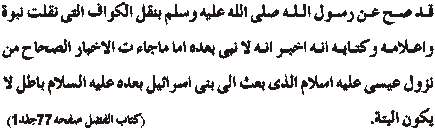
“All those numerous people who have narrated regarding
prophethood of Muhammad (Sallallaho Alaihe Wassallam) his tokens and (verses
of) ‘The Book’, (Quran Majeed), have come forward to uphold his mandate that
there shall be no prophet after him (Sallallaho Alaihe Wassallam). Albeit, it
has been reported in Sahih Ahadith that Hazrat Isa (Jesus), (Allah’s peace be
on him), will descend. He is the same Isa (peace be on him) who was sent as a
Prophet to Bani Israel and whom the Hebrews claimed to have assassinated and
crucified. Therefore, affirmation of this tenet is obligatory that any claim to
the existence of prophethood after the holy Prophet (Sallallaho Alaihe
Wassallam) is fictitious; it can never be”.
(Kitabul
Fasl, Vol. 1, p.77).
At another place, Ibn-e-Hazm,
(Allah’s blessing be upon him) writes:
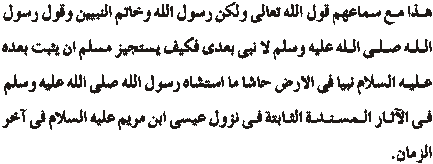

“Having heard Allah’s declaration that he is Allah’s Prophet
and seal over the Prophets and his declaration that “there shall be no prophet
after me”, how can a Muslim consider the sending of anybody as a prophet on the
earth lawful after him (Sallallaho Alaihe Wassallam) except the descent of
Hazrat Isa, (Allah’s peace be on him), towards the last era (of humanity) as
per testified Ahadith-e- Sahihah”.
(Kitabul Fasl, Vol. 4,
p. 180).
At
another place Ibn-e-Hazm further writes:
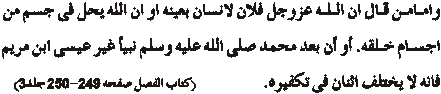
“He who says such and such a person is Allah or says that
Allah has entered into the body of any of those whom He has created or (says)
that there is a prophet after Muhammad (Sallallaho Alaihe Wassallam) excepting
Hazrat Isa bin Mariam, then no two persons can differ that such a sayer is not
an unbeliever (Kafir)”.
(Kitabul Fasl, Vol. 3,
p.249).
Deniers
are infidels
(3) Hafiz Fazlullah Torpushti (d.
630 A.H.) has written a book in Persian on Islamic dogmas namely, Moatamad Filmoataqad. He has given in
it details of the doctrine of Khatme Nubuwwat and has concluded by saying that
those who don’t believe in the finality of the Prophet (Sallallaho Alaihe
Wassallam) are expelled from
Islam. Some important excerpts are reproduced below:

“And out of those articles of (Islamic) faith one is that a
Muslim must admit his Prophethood in the sense that no prophet can ever come
(into the world) whether a rasool (with a Shariat from Allah) or no rasool
(i.e., without a Shariat). The meaning of Khatme Nubuwwat is that the Prophet
(Sallallaho Alaihe Wassallam) sealed the line of prophethood whereby
prophethood came to a finish by his arrival, or it means that Allah terminated
prophethood on him (Sallallaho Alaihe Wassallam) And this termination is Allah’s command which nobody can
disobey”.
(Moatamad Filmoataqad,
p. 94).
At another place, Hafiz Fazlullah
writes:
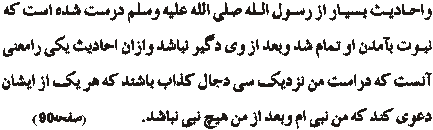
“And many Ahadith from Allah’s Prophet (Sallallaho Alaihe
Wassallam) have confirmed that prophethood did come to an end on his coming
into the world and there shall be no prophet after him. One of these Ahadith
connotes that “There shall be nearly thirty pretenders as liars in my Ummah,
each one of whom will claim that ‘I am a prophet’ but there shall be none after
me”. (Ibid. p.95).
He further writes:
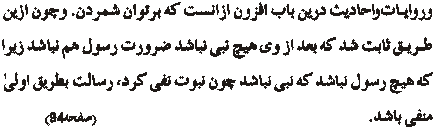
“And Ahadith and narrations in this case are numerous. Being
thus proved that no ‘nabi’ (prophet without a Shariat) shall come after
Muhammad (Sallallaho Alaihe Wassallam) it is thus evident that there shall
neither be a ‘rasool’ (prophet with a Shariat), because there is no ‘rasool’
who is not a ‘nabi’. When ‘nubuwwat’ has been negated, ‘risalat’ stands
expressly void by the logic of anteriority”.
(Ibid. p.96).
Furthermore, Hafiz Torpushti says:
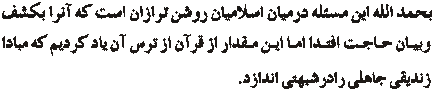
“Thanks to Allah, this subject is too manifest for the
Muslims to need any clarification or explication. We have clarified this
subject so much as we were afraid lest some dualist-infidel should throw an
ignorant person into doubts”.
He continues:

“A denier of the tenet of ‘Khatme Nubuwwat’ can only be a
person who from the very start bore no credibility in the personality of
Muhammad (Sallallaho Alaihe Wassallam) as a prophet, because had he (the
denier) possessed it he would have avowed the veracity of all that the holy
Prophet (Sallallaho Alaihe Wassallam) had spoken about”.
In conclusion Hafiz Torpushti says:
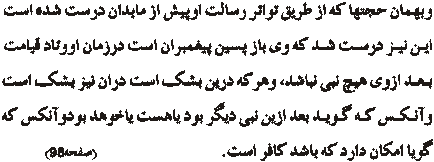
“Those very arguments
which have vouched for Hazrat
Muhammad’s (Sallallaho Alaihe Wassallam) nubuwwat’ and ‘risalat’ based
on unbroken line of Traditions also vouch that he ............ was the last of
the Prophets and that no prophet will ever come either in his lifetime or later
till the Resurrection Day. Therefore whosoever doubts this Khatme-nubuwwat must
also be in a doubt about the risalat of Muhammad (Sallallaho Alaihe Wassallam). Similarly whosoever says there was a
prophet after him or there is one living now or is likely to be born later,
such a person is an infidel”.
(Ibid.,
p.97).
Himself
Misled and Misleading Others
(4) Hafiz Ibn-e-Katheer, (Blessing
of Allah be upon him), writes under Ayat ‘Khatam-un-Nabieen’:
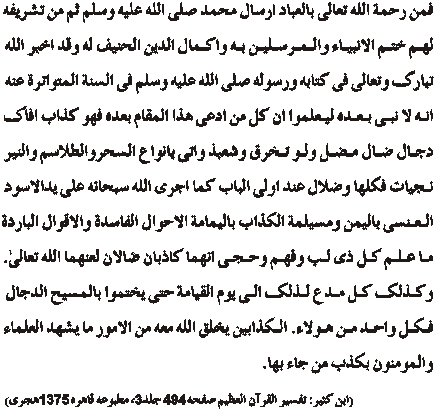
“Sending of Hazrat Muhammad (Sallallaho Alaihe Wassallam) as
a prophet to His creatures is Allah’s great blessing on them. As a further mark
of unique respect and reverence for him, Allah, the Exalted, terminated the
commissioning of all the prophets and messengers on his appearance (Sallallaho
Alaihe Wassallam) and the
religion of piety was perfected for him. Allah the Exalted in his Book and the
Prophet through his unbroken chain of Ahadith have informed mankind that no
prophet will ever be born after him. Hence, the Ummah should know that if a
person lays a claim to this status of prophethood after him (Sallallaho Alaihe
Wassallam) such a person is an arch-liar, a pretender, an impostor,
scandalmonger and a seducer of men who is himself corrupt and is corrupting
others. Men of wisdom will take his so-called prophetic actions as shows of
jugglery, variegated conjurations, spells and sleights and his claim as
fictitious, spurious and depraved, in the same way as Allah, the Exalted,
exposed perverse assertions made by Aswad ‘Ansi (claimant of prophethood) in
Yemen and by Musailma Kazzab (another claimant of prophethood) in Yamama.
Everybody possessing qualities of judgement and discernment identified these
claimants as liars who led the people astray. May Allah’s curse fall on them
and on all those who come to lay any claim in future right till the
Resurrection Day, and they will be obliterated along with Masihiddajjal about
whom Allah, the Exalted, will cause such things to appear as would make Muslims
and their learned religious men testify to his falsity”. (Tafseer Ibn e Katheer, Vol. 3, p.494, Printed Cairo, 1375
A.H.)
Capital
Punishment of Dualist Infidel Obligatory
(5) Allama Safarini Hambli writes in
his Sharah Aqeedah:


“Anybody claiming that
prophethood (is an object which) can be acquired is a
dualist-infidel whose capital punishment is obligatory because his assertion is
his belief that the door of prophethood is not closed. And this belief is in contravention
of the Quranic verses and Mutawatir Ahadith which conclusively prove that our
Prophet (Sallallaho Alaihe Wassallam) was the last of the Prophets” (Peace be
upon them). (Sharah Aqeedah Safarini, Vol. 2,p.257. Printers Almanar,
Egypt, 1323 A.H.).
Who
is a Dualist Infidel?
(6) Allama Zarqani relates from Imam
Ibne Hibban in Sharah Mawahib:
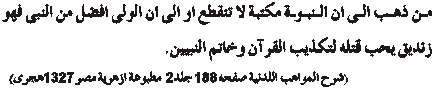
“He who believes that prophethood can be acquired and that
the door of Prophethood is still open or believes that a saint is pre-eminent
over a prophet, such a man is a dualist-infidel. His execution is obligatory
because he accuses the Quran of falsehood in its verses relating to Khatamun
Nabieen”.
(Sharah
Al Mawahib-ul-Laduniya, Vol. 6, p.188, Printers Azhariyah, Egypt, 1327, A.H)
Punishment of a Dualist Infidel
(7) Syed Mahmood Aaloosi Baghdadi in
his Tafseer Roohul Ma’ani
writes under the Ayaat of Khatamun Nabieen:

“The precept of the Last Prophethood of Muhammad (Sallallaho
Alaihe Wassallam) is from those
faith-fundamentals over which the Quran is positive and the Hadith has
clarified them beyond doubt and on which there is complete agreement of the
Ummah. Therefore a believer in contrariety will be decreed a dualist-infidel;
if he insists (in his belief) then he should be given capital sentence”.
(Roohul Ma’ani, Vol.
22, p.41).
Different
Types of Infidels
(8) Qazi Ayaz writes in Al Shifa:
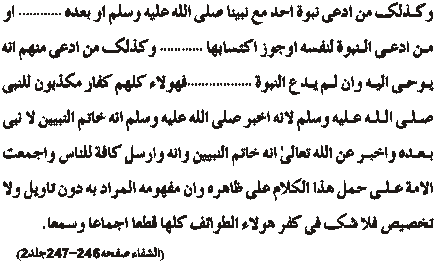
“Similarly, if a
person declares somebody to be a prophet along with our Prophet or after him
(Sallallaho Alaihe Wassallam) or claims prophethood for himself or considers
acquisition of prophethood legal or thinks this status is possible through
self-purification; or without claiming prophethood for himself, says Allah’s
Revelation ‘wahi’ descends upon him, then such a person is infidel (kafir)
because he accuses the Prophet (Sallallaho Alaihe Wassallam) of false reporting
about his status as Khatam un Nabieen having been commissioned for the entire
mankind. The whole Ummah is unanimous that this word (Khatam un Nabieen) is
clear in its sense and does mean only what it manifests, sans any
interpretational paraphrasing. All types of claimants are infidels without
doubt and their infidelity (kufr) is certain from the point of view of the holy
Book, the Sunnah and concurrence of the Ummah”.
(Al Shifa, Vol. 2,
pp.246-247).
Dualist
Infidels publicly guillotined
At another place, Qazi Ayaz writes:
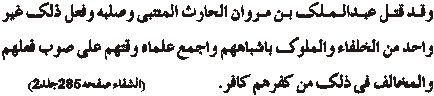
“And Caliph Abdul Malik bin Marwan had Harith, a claimant of
prophethood, beheaded and his dead body hung from the gallows. Many Caliphs and
kings treated such types of claimants of prophethood in this very manner and
the religious scholars of those days unanimously declared their actions correct
and proper. Therefore, anybody who is against this consensus is himself an
infidel (kafir)”.
(Al-Shifa, Vol. 2,
p.257).
WRITTEN VERDICTS
OF JURISTS OF UMMAH
(1) Fatawai-Alamgiri
Who is not a Muslim?


“If a person does not have the belief that the holy prophet
Muhammad (Sallallaho Alaihe Wassallam) is
the last of the Prophets then he is not a Muslim. If he says, “I am a prophet
of Allah” or says in Persian language, “I am ‘Paighamber’, thereby meaning “I
convey Allah’s message,” then he also becomes an infidel (kafir)”. (Fatawa Hindiya, Vol. 2, p.363, printed Bolaq, Egypt).
(2) Fatawai-Bazzazia
Claimant of Prophethood is an infidel (Kafir).

“If a person claims prophethood and another asked him to
show a miracle then this man who has asked becomes an infidel according to some
and some said, ‘No’.” (Fatawa Bazzazia on Hashiah Alamgiri, Vol. 6, p.328. Printed Bolaq, Egypt).
(3) Bahrur Raiq
Sharah Kanzud Daqaiq
Who is an infidel (Kafir)

“If somebody says with a word of doubt, viz., “If the
Prophet’s assertion is correct and true”, then he becomes a kafir. Similarly,
if he claims that he is Allah’s prophet, then he becomes a kafir and the man
who asks that claimant to produce a miracle, also becomes a kafir. But some
persons do not classify him so, in case he (who demanded a miracle) intends to
prove the inability of the claimant”.
(Bahrur Raiq Sharah Kanzud
Daqaiq, Vol. 5, p.130, Printed Beirut).
(4) Jame ul
Fasulain
“Demander of Miracle from Claimant of Prophethood is also
Kafir”


Somebody said, “I am a prophet”, or said in Persian
language, “I am a Paighamber” meaning thereby, “I am carrier of Allah’s
message”, then he will become a kafir. If someone asked him for a miracle then
the person who has asked so will also become a kafir. Later theologians have
said that if his intent was to humble that claimant then he would not be deemed
a kafir”.
(Jame ul Fasulain, Vol.
2, p.303, Printed Azhar, Egypt, 1300 A.H.).
(5) Fiqah Shafa’i Mughni ul Muhtaj Sharah Minhaj
Ten types of Kafirs
In this book, which contains
standard ‘fatawa’ of Fiqah Shafai, is written:
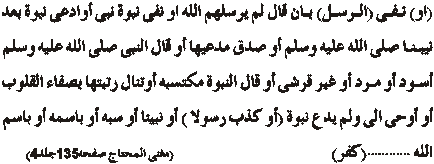
“A person will become a kafir if (1) he rejects the Prophets
and (2) says Allah, the Exalted, did not send them, or (3) negates the
prophethood of some specific prophet, or (4) claims prophethood for himself
after our holy Prophet (Sallallaho Alaihe Wassallam) or (5) affirms such a
claimant’s prophethood, or (6) says that our Prophet (Sallallaho Alaihe
Wassallam) was dark-coloured, beardless and not a Qureshi, or (7) says
that prophethood can be acquired or that status can be ‘achieved through piety
and purity of heart, or (8) says Allah’s Revelation (Wahi) comes to him without
laying any claim to prophethood, or (9) calls any prophet a liar and reviles
him or scorns him, and (10) despises the name of Allah, the Exalted”. (Mughni ul Muhtaj, Vol. 4, p. 135)
dark-coloured, beardless and not a Qureshi, or (7) says
that prophethood can be acquired or that status can be ‘achieved through piety
and purity of heart, or (8) says Allah’s Revelation (Wahi) comes to him without
laying any claim to prophethood, or (9) calls any prophet a liar and reviles
him or scorns him, and (10) despises the name of Allah, the Exalted”. (Mughni ul Muhtaj, Vol. 4, p. 135)
(6) Fiqah
Hambali: Mughni Ibn Qudamah
Follower of Claimant of prophethood is also an apostate.
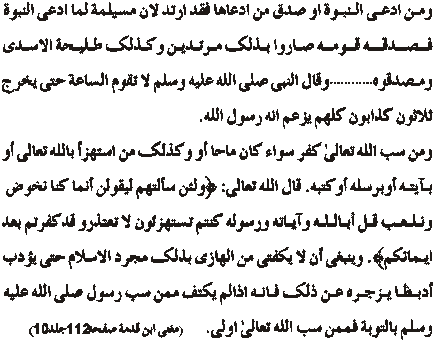
From Mughni ibn Qudamah which is standard ‘Fatawa’ of Fiqah
Hambali: “A person becomes a ‘murtad’ or an apostate (i.e., renouncer of the
Faith) if he claims Prophethood for himself or testifies to a claimant’s
prophethood. Therefore the supporters of Musailma were adjudged apostates
because they testified to Musailma’s claim of prophethood. The same is true of
Tulaiha Asadi and his followers. Prophet Muhammad (Sallallaho Alaihe Wassallam)
declared that Resurrection will not take place until thirty liars have not come
forward each one of whom will claim that he is Allah’s prophet”.
“Anybody who, (Allah forbid), abuses Him is a kafir even if
he forgets at that moment what he is doing, or says so in a joke or in reality.
That person is also kafir who makes fun of Allah the Exalted, or ridicules His
Ayaat or His prophets or His Books. Allah, the Exalted, says in the holy Quran:
“And if you ask them they will say ‘We were just amusing (ourselves) and
jesting’. You ask them ‘Were you jesting with Allah, His Ayaat and His Prophet?
Don’t make excuses. You have become kafir after accepting the (true) faith’.”
“Therefore, a person who commits an act of derision should
not be left to his (lip profession of) Islam only but should be punished and
given a lesson and taught some wisdom as a deterrent lest he should relapse
into this mischief. When penitence alone is not deemed adequate (exoneration)
for saying indecent words against the holy Prophet (Sallallaho Alaihe
Wassallam) then the one who says arrogant words against Allah the Most High
deserves punishment pre-eminently.”
(Mughni Ibne Qudamah,
Vol. 10, p. 112).
(7)
Al Sharah al Kabir Sharah ul Muqney
Which
is a standard fatawa’ of Hambali jurisprudence also contains the same passage
word for word as quoted above from Mughni
Ibne Qudamah.
(Sharah Kabir on
Hashiah Mughni, Vol. 10,p. 111).
TO CONCLUDE
It stands proved in the above
written lines, that (1) the holy Quran, (2)unbroken chain of “Mutawatir”
Ahadith, (3) Juristic Verdicts and (4) Consensus of the Ummah vouch that the
holy Prophet Muhammad (Sallallaho Alaihe Wassallam) was the terminator of the
entire chain of venerable prophets with no exception (peace be on them).
Therefore no person after him (Sallallaho Alaihe Wassallam) can be called a
prophet in any meaning or sense and nobody can fix for himself a prophetic
stance by his guile or guise. Consequently, he who does so or tries to do so or
if anybody believes in the prophethood of that claimant, then such a person is
a cast-off from the fold of Islam.
And this ‘finality’ of the holy
Prophet (Sallallaho Alaihe Wassallam) is a status which is most dignified, an
honour most distinguished and an esteem most high. It is therefore a grave
insult to the holy Prophet (Sallallaho Alaihe Wassallam) if somebody is so
insolent as to lay a claim to the line of prophethood.
Moreover, even if one stretches
one’s human imagination to the farthest end and presumes there is some prophet
who has come in the world, he should seek for a proof to substantiate his
hypothesis, i.e., whether or not this new-comer-of-the-prophet has been
doctrinated with some fresh disciplines. If it is said that no new learnings
were given to the new prophet; rather the same learnings were again revealed to
him as had already been revealed to the holy prophet Muhammad (Sallallaho
Alaihe Wassallam), that would be an inexplicable repetition. With the existing
Prophetic learnings and the undiminishing Quranic reservoir of knowledge, such
repetition by the “new prophet” should turn into a divine exercise in futility,
whereas Allah the Exalted is absolutely above anything futile. And if the plea
is that this later claimant to prophethood was specifically bestowed with such
learnings as were not conferred upon the holy Prophet (Sallallaho Alaihe
Wassallam) then this is (Allah forbid) tantamount to (1) belittling doctrinal
learnings sent by Allah through the holy Prophet (Sallallaho Alaihe Wassallam)
(2) insinuating that the Quran Hakeem lacks completeness despite its
declaration of being (arabi-73) (Charter encompassing the entire religious
matters), and (3) hinting at the imperfection of the Islamic faith, thereby
disbelieving in the Quranic verse (arabi-73) (“This day have I perfected your
religion.”) Such thoughts and actions heap worst indignity upon the holy
Prophet (Sallallaho Alaihe Wassallam) the glorious Quran and the religion of
Islam.
Moreover, if just for the sake of
argument, it is supposed that there is a prophet after our holy Prophet
(Sallallaho Alaihe Wassallam) then as a natural corollary it will become
incumbent upon all to express allegiance to him and believe in whatever he says
or does; and conversely disbelief in him will be deemed infidelity and ‘Kufr’!
— Otherwise what else could prophethood signify? Such supposition in effect
amounts to insulting the holy Prophet (Sallallaho Alaihe Wassallam) and finding
fault with him to the extent that one who believes in him and his entire ‘Deen’
is deemed a ‘Kafir’ deserving Hell for ever. It would mean that even belief in
the holy Prophet Muhammad (Sallallaho Alaihe Wassallam) would (Allah forbid)
not be adequate to protect him from ‘Kufr’ and the Hell!
May Allah the Exalted grant all the
Muslims His Graciousness to remain attached to the cloak of the holy Prophet
Muhammad (Sallallaho Alaihe Wassallam)
Wa aakhiru d’awana anilhamdu lillahi Rabbil Aalameen,
Wa Sall Allahu Ta’ala Ala Khairi Khalqihi Saiyyidna
Mahammad Wa Aalihi Wa Ashabihi Ajmaeen.
MUHAMMAD YUSUF LUDHIANVI
“ahmedi”
or “qadiyani”?
The followers of mirza ghulam ahmed,
who was born in qadiyan, are qadiyani whether they belong to the qadiyani
jamaat of rabwah (Chanab Nagar) or the lahori jamaat of qadiyanies. But these
people call themselves “Ahmedis.” Their calling themselves as “Ahmedi” rests on
the plea that mirza ghulam ahmed qadiyani befits the verse (arabi-2) in the
holy Quran. Whereas according to the Muslims this Quranic verse relates to the
holy Prophet Muhammad (Sallallaho Alaihe Wassallam).
Taking undue advantage of the word,
“Ahmad”, in his name, mirza ghulam ahmed twisted the meaning of the Quranic
verse (arabi-2) in his favour and claimed Prophethood on this basis, though his
name, ‘ghulam Ahmed’, actually means: “slave of Ahmed.” According to the holy
Quran both ‘Ahmed’ and ‘Muhammad’ are the holy names of our Prophet (Sallallaho
Alaihe Wassallam)
Therefore, the application of the
said Quranic verse to mirza ghulam ahmed qadiyani is a deliberate alteration in
the Holy Quran. On this basis calling qadiyanies as “Ahmedis” is “Haraam”
(forbidden) and unlawful.